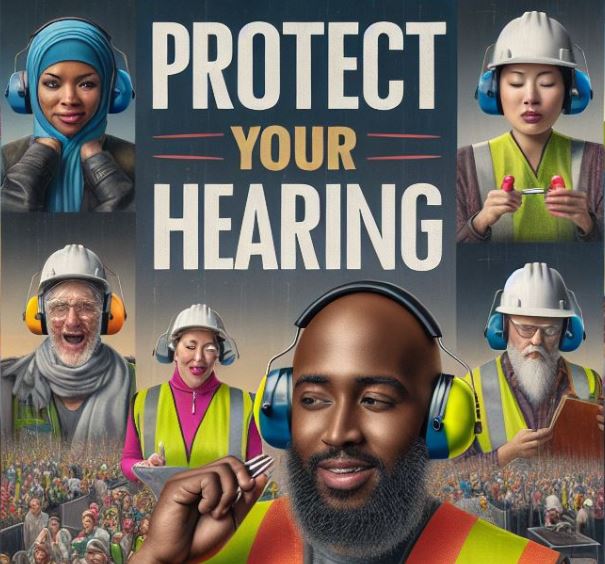
When engaging in shooting activities, protecting your hearing is crucial due to the high noise levels, which can exceed 140 dB.
Here are my top 5 recommendations to ensure your ears are well-protected:

1. Consider the Environment
Where you shoot should influence your selection of hearing protection. Shooting outdoors or in open areas allows sound to dissipate more quickly, reducing the overall noise impact. Indoor shooting, however, can expose you to much higher and more intense noise levels, as sound does not dissipate quickly and can exceed 140 dB (decibels). Always ensure you have adequate hearing protection regardless of the setting.

2. Consider the Equipment Rating (NRR)
Price is not always an indication of what's good or best; performance is critical. NRR stands for Noise Reduction Rating, which indicates how much the equipment reduces noise. More protection is better, and the higher the NRR, the better!

What's the best available NRR so far?
- High-quality foam plugs that fit correctly in the ear are around 33 dB.
- For earmuffs, the highest NRR is generally around 31 dB.

You might think a 30 NRR device reduces 90 dB noise down to 60 dB, but that's not how it works.

The effective noise reduction is based on a formula:
1. Reduce the advertised NRR by 7 to account for laboratory vs. real-world conditions.
2. Divide what's left by 2 to get a more realistic estimate of protection.

So, 30 NRR => 30 - 7 => 23 / 2 => 11.5 Effective Protection.

Apply that to 90 dB, and you get a reduction down to 78.5 dB!

Indoor gun ranges can be as loud as 140 dB, and sounds above 85 dB can damage hearing.

This is why we sometimes recommend using both earmuffs
and earplugs (double up).

3. Electronic Earmuffs
These earmuffs can amplify low-level sounds like range commands while still providing high-level noise reduction. However, they should be evaluated on their level of reduction and their reaction time to suppress loud sounds. The protection amplifies sounds and then acts to suppress loud sounds; if they don't react fast, you get less protection.

Look for earmuffs with a Noise Reduction Rating (NRR)
of at least 30 dB.

Some top-rated options include:
- 3M Peltor X5A Over-the-Head Earmuffs (NRR: 31 dB)
- Howard Leight by Honeywell Impact Pro (NRR: 30 dB)

4. Can You Tell the Difference?
There is a real difference between sound power (energy/intensity) and what we actually hear. If we increase our hearing protection NRR by 3, it actually cuts the sound power in half. But to human ears, it takes almost a 10 dB increase in NRR to perceive that difference. (The 3 dB only sounds like a slight decrease to most people.)

5. Finally, Know Who Says So
Vendors make claims about the performance of their equipment, but sometimes they may not be realistic.

There are several standard certifications one might look for, but if you don't see any, that may be an indication for a buyer beware attitude.

The primary standard used in the United States is:
ANSI S3.19-1974.

An updated standard that includes two testing methods is:
ANSI/ASA S12.6-2016.

* The Environmental Protection Agency (EPA) requires that all hearing protection devices sold in the U.S. display their NRR based on the ANSI S3.19-1974 standard.

So always "stay well aware, well informed, and well protected."